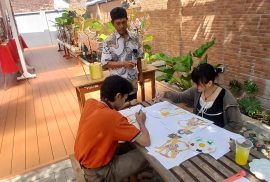
Gadjah Mada University (UGM), through a community service program led by Dr. Rudy Wiratama, S.IP., M.A., from the Faculty of Cultural Sciences (FIB), is implementing a program titled “Preservation and Conservation of the “Tatah Sungging Wayang Kulit” Tradition in the Tourist Village of Butuh, Sidowarno, Wonosari, Klaten, through Capacity Building for Artisans and an Exhibition of the Community’s Signature Products.” This program is a collaborative effort to strengthen the sustainability of the Tatah Sungging tradition while enhancing the community’s economic value based on local cultural potential.

A total of 28 students from Gadjah Mada University, who are members of the UGM Manapak Mamuju 2026 KKN-PPM Team, are currently carrying out a community service program on the western coast of Sulawesi Island, specifically in Mamuju Regency, West Sulawesi Province. Now in the third week of the KKN program, the students have implemented various community empowerment programs at two service locations: Sumare Village and Tapandullu Village. One of the flagship programs currently underway is the conservation of the maleo bird.
Behind the lush greenhouses standing in Bulakbanjar Hamlet, Banjarharja Village, Kalipucang Subdistrict, Pangandaran Regency, lies the long story of a local resident who turned his hobby into a promising orchid business with the potential to become an educational tourist destination. He is Wahyu Wibisono, owner of Wibi Orchid Nursery, assisted by Abah Wahli Supriyadi—the two figures behind this thriving venture that has penetrated the national market and attracted visitors’ attention.
The cocoa supply chain in Kuwum Village was the focus of a community service project by UGM KKN-PPM students, who shared the recommendations from a policy brief with the Village-Owned Enterprise (BUMDes) and the Cocoa Farmers’ Group.
During the event, the students also distributed a guidebook on cocoa processing—from farm to value-added products—as part of an effort to strengthen the management of the village’s flagship commodity.
Universitas Gadjah Mada (UGM) once again demonstrates its commitment to community service thru the Student Community Services – 2026 Sumatera Disaster Response (KKN – Peduli Bencana Sumatera 2026) program. This program is a tangible manifestation of UGM’s contribution in supporting the post-disaster recovery phase thru a multidisciplinary approach focused on the sectors of infrastructure, health, and education. This community service activity is carried out over 30 days from late January to early March 2026.

Swarna Bandar, a team of Universitas Gadjah Mada Students Community Services (KKN UGM) unit, encourages the development of coffee as a leading commodity in Kledung Village, Pacitan Regency. The efforts made by all KKN UGM students was aimed at optimizing the village’s agricultural potential, which has not been managed optimally.
Behind the expanse of agricultural land and tea gardens in Sapuran District, Wonosobo Regency, lies the local potential of bamboo plants, which have often been considered as wild plants and therefore have not been optimally utilized. Through the Sapuran Berperan – UGM Students Community Services (KKN UGM), students are present to change this perception through various innovative work programs oriented towards community empowerment. This effort is in line with the theme, namely “Optimizing Local Potential and Productive Human Resources through the Development of Bamboo-Based Socio-Enterprises and Integrated Agriculture to Realize Sustainable Village Development.”

Universitas Gadjah Mada Students Community Services (KKN) team, Kita Morotai, successfully held the 2026 Rao Rayo Festival in Posi-Posi Rao Village, Rao Island District, Morotai Island Regency, North Maluku, on Thursday, February 2, 2026. This annual festival, themed “Celebrating Coastal Cultural Traditions,” served as a space for celebrating coastal culture while strengthening local identity. The event involved five villages, namely Posi-Posi Rao, Saminyamau, Leo-Leo, Aru Burung, and Lou Madoro. The series of events was centered in the village port area, which was transformed into an open cultural stage. The festival was a manifestation of the collaboration between KKN students, local government, and the community in preserving traditions in a sustainable manner.

Kledung Village is one of the villages located in Bandar Subdistrict, Pacitan Regency, East Java, with a mountainous landscape that has high potential for agriculture and plantations. One of the existing potentials is coffee plants. The favorable geographical conditions, with highlands and sufficient rainfall, indicate that Kledung Village has great potential for developing coffee as a commodity. This has opened up opportunities for the Swarna Bandar UGM Student Community Services to promote coffee as a leading local commodity in Kledung Village.


